$500 GIFT City Investment Fund: A Game-Changer for Global Investors

By: GARGEE DESHPANDE ACCA

For the first time ever, global investors can access professionally managed Indian equity funds with just $500, thanks to a revolutionary development at GIFT City, India’s only International Financial Services Centre. Tata Asset Management’s India Dynamic Equity Fund pioneers this new category of low-minimum inbound retail funds, shattering the $150,000-plus barrier that once restricted offshore investment access to ultra-wealthy and institutional players.


What Is GIFT City?

Gujarat International Finance Tec-City (GIFT City) is a Special Economic Zone functioning as a ‘deemed foreign jurisdiction’ on Indian soil.

  • Offshore treatment under FEMA while onshore physically
  • Multicurrency operations in USD, EUR, GBP
  • Unified regulation by IFSCA, combining RBI, SEBI, IRDAI, and PFRDA powers


Tata India Dynamic Equity Fund: Structure & Strategy

Tata’s retail-focused inbound feeder fund provides foreign investors seamless access to India’s equity markets:

  • 50–100% allocation to broad-based Indian equity funds
  • Up to 50% in sectoral/thematic opportunities (technology, healthcare, energy)
  • Diversified across large-, mid-, and small-cap segments
  • Dynamic rebalancing based on market conditions for risk management and growth


Investor Eligibility & Minimum Investment

  • Minimum Investment: $500, democratizing access to retail and institutional investors
  • Eligible Investors: NRIs, FPIs, OCIs, foreign institutions.


Tax Benefits for International Investors

GIFT City’s IFSC offers unmatched tax efficiency

  • Zero capital gains tax on qualifying redemptions
  • No STT or DDT on fund trades and dividends
  • Stamp duty & GST exemptions on transactions
  • Repatriation of principal and gains under bilateral DTAAs


How to Invest: Process & Documentation

  1. Select a Financial Advisor: GIM Wealth will help you with the entire process
  2. Open Foreign Currency Account: No NRE/NRO needed for NRIs
  3. Complete KYC:
    • Proof of Identity (any one): PAN Card, Aadhaar, Passport, Driving License, Voter ID
    • Proof of Address (any one): Aadhaar, Passport, Utility Bill (<3 months), Bank Statement, Rent Agreement
    • Passport-size photograph, in-person verification, bank reference letter
  4. Fund Transfer: SWIFT USD directly to fund account
  5. Subscription: Minimum $500, NAV quoted in selected currency


Comparison with Other Investment Routes

Feature Tata India Dynamic Equity Fund Traditional GIFT City Funds Direct Foreign Investment
Minimum Investment $500 $150,000+ Varies by broker ($5,000+)
Investor Eligibility NRIs, FPIs, Residents under LRS HNWI & Institutions Varies by jurisdiction
Tax Benefits Zero capital gains, no STT/DDT Zero capital gains Subject to local taxation
Professional Management Tata AMC Yes Self-directed
Currency Options USD USD Local currency


FAQs About GIFT City Investments

Is GIFT City good for investment?
Yes. GIFT City combines tax advantages, multicurrency operations, and unified regulation. Tata’s $500 fund unlocks retail access to these benefits.

Can a resident Indian invest?
No, resident Indians cannot invest.

What is the minimum investment?
Just $500, compared to $150,000+ for other GIFT City funds.


Conclusion

Tata Asset Management’s launch of the $500 minimum India Dynamic Equity Fund at GIFT City marks a historic democratization of global investing. By combining low entry barriers, tax efficiency, multicurrency banking, and unified regulation, this fund empowers investors worldwide to participate in India’s growth.

Act now: Consult your financial advisor, complete KYC, and secure your spot in India’s growth story with just $500.


Sources:

  1. https://www.hdfcbankgiftcity.com/gc/personal/resources/learning-centre/save/an-detailed-overview-of-ifsc-gift-city
  2. https://www.idfcfirstbank.com/finfirst-blogs/nri/gift-city-tax-benefits
  3. https://www.pwc.in/ifsc.html
  4. https://www.moneycontrol.com/news/business/markets/tata-asset-management-receives-approval-to-launch-dynamic-equity-fund-at-gift-city-13551380.html
  5. https://www.angelone.in/news/mutual-funds/tata-amc-secures-approval-to-introduce-tata-india-dynamic-equity-fund-at-gift-city
  6. https://www.linkedin.com/posts/neil-borate-1a435a57_tata-amc-is-launching-the-first-major-retail-activity-7373575656946909184-jug3
  7. https://www.jpmorgan.com/IN/en/about-us/gift-city


Legal and Regulatory Pathways for Australian SMSF Investment in Indian Mutual Funds

An Independent Research Report on Compliance, Statutory Basis, and Investment Plans for SMSFs

Research Report by: Gargee Deshpande, GIM Wealth

Executive Summary

This report explains the legal and regulatory grounds that permit Australian Self-Managed Super Funds (SMSFs) to invest in Indian mutual funds, through both the established domestic route and the newer GIFT City (IFSC) channel. All references are to current Australian and Indian laws and regulatory guidance as of July 2025.

  1. Statutory and Regulatory Foundations

Australian SMSF Provisions

Area Regulation / Section Requirement
Sole Purpose Rule SIS Act 1993 s.62 Investments must provide solely for retirement benefits.
Investment Strategy SISR Reg 4.09 The strategy must address international assets and risk.
Asset Segregation SIS Act s.52B(2)(d), SISR Reg 4.09A All SMSF assets, including those held offshore, must be kept separate from members’ personal assets.
Audit and Reporting SIS Act s.35C, s.35A Annual audit must cover all foreign holdings; documents required.
Residency & Control SIS Act s.42, ITAA 1997 s.295-95(2) Management and control of the investor/ trust must remain in Australia.

Explanation:
Australian SMSF regulation does not restrict investments in overseas mutual funds as long as these conditions are met. The investment must be for retirement benefit, with full compliance and documentation under the above-cited sections.

Indian Regulatory Framework

Area Authority / Regulation Requirement
NRI/OCI Eligibility FEMA, SEBI MF Regulations, RBI directives NRIs/OCIs (including Australian residents) may invest via NRE/NRO accounts, after completing KYC and PAN registration.
GIFT City Mutual Funds/AIFs IFSCA MF/AIF Regulations Structured for NRI/OCI investments, subject to KYC, minimum subscription, and regulatory requirements.
Taxation & Double Taxation Indian IT Act, India–Australia DTAA Investment returns are taxed in India; tax credits or relief available under treaty rules.

Explanation:
Indian law, by way of FEMA, SEBI MF regulations, and IFSCA directives, permits NRI/OCI participation in mutual funds (and, where eligible, GIFT City funds) provided all due diligence (KYC/PAN) is complete and all investments are through proper accounts.

  1. Recognition and Practical Notes
  • Documentation and Compliance:
    Proof of NRI/OCI status, up-to-date KYC, PAN, and appropriate Indian bank account (NRE/NRO) are required. Indian mutual fund houses and intermediaries set their own additional operational procedures, which must be followed for account setup, investment, and repatriation.
  • GIFT City Channel:
    Investments into GIFT City mutual funds/AIFs are subject to IFSCA rules. Most AIFs require a higher entry amount; accessible retail products remain limited but legally permitted for eligible NRIs/OCIs.
  • Taxation:
    Returns are subject to Indian taxation; supporting documentation (such as TDS certificates) must be kept for tax relief under the India-Australia Double Taxation Avoidance Agreement.
  1. Areas of Support
  • Investment Advisory and Research: Advise on the best possible investment routes and funds as per the requirements of the clients.
  • Guidance on Documentation:
    Assistance in organizing and completing Indian KYC, PAN, and account opening documents so that investments meet all regulatory standards.
  • Process Support:
    Advice throughout the steps required by Indian intermediaries or fund houses (mutual funds, bank, GIFT City entities) to ensure smooth application, transaction, or repatriation.
  • Audit Documentation:
    Help in compiling, translating, or presenting Indian investment documents for annual compliance or audit requirements.
  • Information on Taxation and Succession:
    Clarification on how Indian taxes apply and what is needed to document repatriation, nominee arrangements, or succession of assets in India.
  1. Conclusion

Australian SMSFs are permitted, under cited sections of Australian and Indian law, to invest in Indian mutual funds or GIFT City structures if all regulatory requirements are satisfied. With the correct documentation and process, and in line with both countries’ laws, trustees can structure these cross-border investments with regulatory confidence.

Support is available specifically for documentation, regulatory process guidance, Indian tax, repatriation procedures, and succession planning, ensuring compliance without management or custody of investor funds.

Embrace the V Shape SIP Strategy: Turn Market Downturns into Opportunities

When starting a Systematic Investment Plan (SIP), many investors are often hesitant to begin during market peaks, fearing a subsequent decline. However, what if we told you that even if you start your SIP at the top of the market and the markets start rolling down, you can generate handsome returns when the market recovers? This powerful concept is called ‘V shaped SIP strategy’ and we have data to support it.

The V shape SIP concept:

The V shape SIP concept revolves around the idea that market downturns should not deter you from investing. In fact, they can be a strategic opportunity. When you start a SIP at a market high and the market declines, your regular investments buy more units of the fund at lower prices. When the market eventually recovers, these additional units purchased at lower prices significantly enhance the value of your investments, leading to substantial returns.

Real-world data to support the ‘V Shape SIP Strategy’:

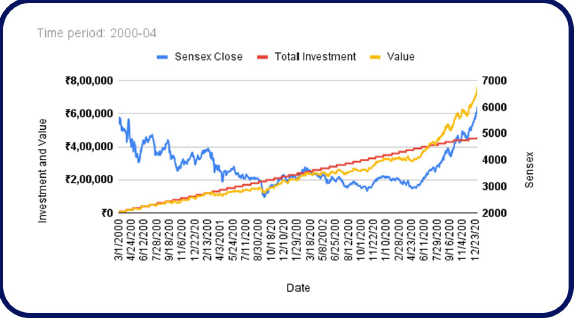
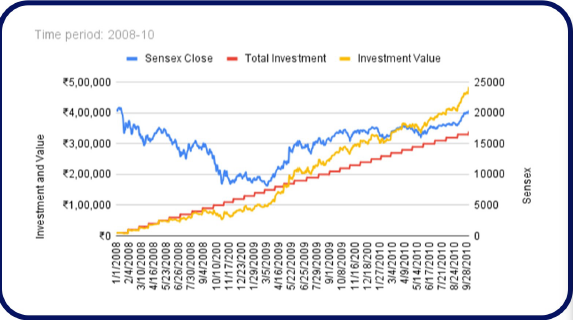
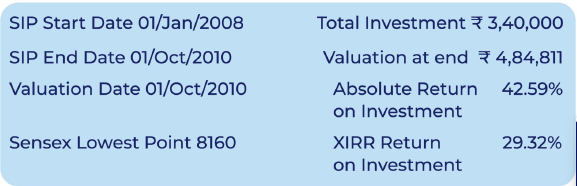
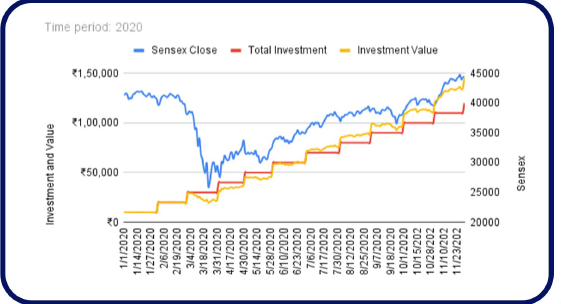
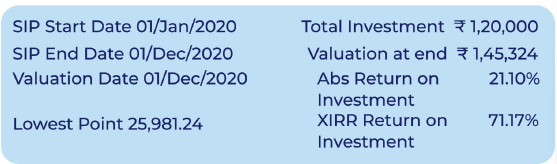
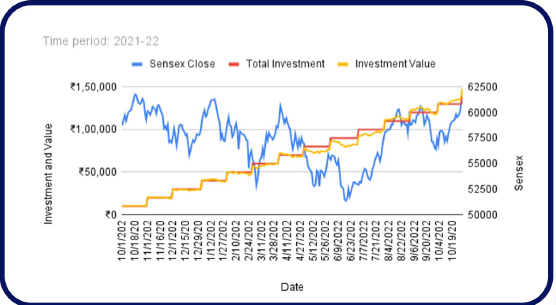
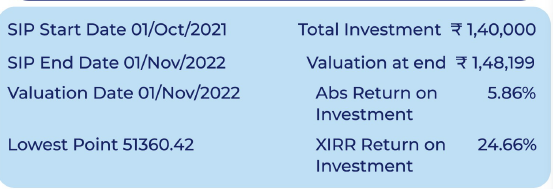
Let’s delve into the data to see how this strategy performs in practice. The charts below illustrate the performance of Rs. 10000 SIP started at different market peaks in Sensex, showcasing how the investment fared as the market declined and eventually recovered.

Key Takeaways:

  1. Market Downturns as opportunities: The data shows that starting a SIP during market peaks and continuing even during market crashes can result in acquiring more units at lower prices, potentially increasing future returns.
  2. Consistent Investment pays off: Despite initial negative returns during market lows, consistent investment during these periods ultimately resulted in significant gains once the market rebounded.
  3. Compounding benefits: The additional units purchased during the downturns compound over time, leading to exponential growth in the investment value when the market recovers.

Why start an SIP regardless of market conditions?

  1. Rupee cost averaging: Regular investments spread across market highs and lows average out the purchase cost, reducing the impact volatility.
  2. Discipline and convenience: SIPs instill a disciplined investment habit, making it easier to stay invested through market cycles.
  3. Long term growth– Historical data shows that markets tend to grow over the long term, rewarding patient and consistent investors.

Conclusion:

The ‘V shaped SIP strategy’ is a testament to the power of consistent investing, even in the face of market downturns. By leveraging market declines to your advantage, you can accumulate more units at lower prices and benefit significantly when the market rebounds. So, don’t delay your SIP investments waiting for the perfect time. Start now, stay consistent, and let the market work in your favour over the long run. Embrace the V shape SIP strategy and turn market volatility into your wealth- building ally.

The Power of Compound Interest: How to Grow Your Wealth Over Time

Investing in mutual funds is a popular strategy for growing wealth, and one of the key benefits is the power of compound interest. This blog will explore how compound interest works and how you can harness it to maximize your returns through mutual funds.

Understanding Compound Interest

What is Compound Interest?

Compound interest is the process where the interest earned on an investment is reinvested, allowing you to earn interest on both the initial principal and the accumulated interest. This creates a snowball effect, where your investment grows exponentially over time.

How Does It Work?

Let’s break it down with a simple example. Suppose you invest ₹10,000 in a mutual fund with an annual return of 8%. In the first year, you earn ₹800 in interest, bringing your total to ₹10,800. In the second year, you earn interest on ₹10,800, not just the original ₹10,000. This means you earn ₹864, and your investment grows to ₹11,664. Over time, this compounding effect can significantly increase your wealth.

The Role of Mutual Funds in Compounding

Reinvestment of Earnings Mutual funds often reinvest the earnings from dividends and capital gains back into the fund. This reinvestment is crucial for compounding, as it allows your investment to grow faster. By choosing to reinvest your earnings, you can take full advantage of compound interest.

Diversification and Professional Management Mutual funds offer diversification by investing in a variety of securities, which can help mitigate risk. Additionally, professional fund managers make strategic decisions to maximize returns. This combination of diversification and professional management can enhance the compounding effect.

Benefits of Compound Interest in Mutual Funds

Exponential Growth The most significant benefit of compound interest is exponential growth. The longer you stay invested, the more your money can grow. This makes mutual funds an excellent choice for long-term financial goals, such as retirement or education savings.

Time is Your Ally The power of compound interest is magnified over time. Starting early and staying invested for the long term can lead to substantial wealth accumulation. Even small, regular investments can grow significantly due to compounding.

Example of Compound Interest in Mutual Funds Consider an investment of ₹5,000 per month in a mutual fund with an average annual return of 10%. After 20 years, your total investment would be ₹12,00,000. However, due to compound interest, your investment could grow to over ₹38,00,000. This example illustrates how powerful compounding can be when combined with regular investments and time.

Tips to Maximize Compound Interest in Mutual Funds
Start Early: The earlier you start investing, the more time your money has to grow.
Reinvest Earnings: Opt for reinvestment of dividends and capital gains to maximize compounding.
Stay Consistent: Make regular investments to take advantage of dollar-cost averaging and compound interest.
Be Patient: Allow your investments to grow over time without being swayed by short-term market fluctuations.

Conclusion
The power of compound interest can transform your financial future, especially when leveraged through mutual funds. By understanding how compound interest works and making strategic investment decisions, you can grow your wealth significantly over time. Start early, stay consistent, and let the magic of compounding work for you.

Source :

1) https://techbullion.com/the-power-of-compound-interest-in-mutual-fund-investments/

2) https://www.investopedia.com/terms/c/compoundinterest.asp

3) https://www.supermoney.com/encyclopedia/compounding-interest

Peer-to-Peer Lending in India: A Game Changer for Borrowers and Investors

Peer-to-peer (P2P) lending platforms are disrupting the traditional lending landscape in India. By connecting borrowers directly with lenders, they offer greater flexibility, transparency, and potentially better rates compared to banks. Here’s what’s making P2P lending a hotbed of activity:

  • Bridging the Credit Gap for MSMEs: Small and medium enterprises (MSMEs) are the backbone of the Indian economy, but access to affordable credit remains a challenge. P2P platforms cater to this underserved segment by offering quicker loan approvals and more flexible repayment options.
  • Focus on Rural Lending: Financial inclusion is a major priority in India. P2P platforms are reaching out to the unbanked and underbanked population in rural areas, providing them with access to much-needed credit for agricultural activities and micro-entrepreneurship.
  • Rise of Alternative Credit Scoring: Traditional credit bureaus often overlook individuals with limited credit history. P2P platforms are employing alternative credit scoring methods that consider factors like cash flow, digital footprints, and social media data to assess creditworthiness, enabling a more inclusive approach.
  • Collaboration with Fintech and NBFCs: P2P platforms are forging partnerships with fintech companies to leverage advanced fraud detection and risk management tools. Additionally, collaborations with Non-Banking Financial Companies (NBFCs) are creating a wider range of loan products and facilitating institutional investment in the P2P space.
  • Regulatory Scrutiny and Investor Protection: With the rapid growth of P2P lending, the RBI is rightfully amping up regulatory scrutiny. This includes stricter guidelines for platform governance, risk management practices, and investor disclosures, ensuring a safe and secure environment for all stakeholders.

Insurance Industry in India: A Booming Market Poised for Exponential Growth with InsurTech at the Forefront

The Indian insurance sector is a powerhouse on the rise. With a projected market size of USD 400 billion by 2025, it’s no surprise that both domestic and international players are scrambling for a piece of the pie! Here’s a deeper dive into the hottest trends shaping the landscape:

  • InsurTech Revolution: Technology is transforming the way insurance is bought, sold, and serviced. InsurTech startups are leveraging AI, blockchain, and big data to personalize policies, streamline claims processing, and automate risk assessment.
  • Data-Driven Underwriting: Gone are the days of one-size-fits-all premiums. Insurers are now utilizing telematics (data collected from connected vehicles) and health wearables to create customized pricing based on individual risk profiles. This not only benefits responsible policyholders with lower premiums but also allows insurers to expand coverage to previously underserved segments.
  • Focus on Protection Beyond Life and Health: The demand for protection against unforeseen events is rising. Personal accident insurance, critical illness covers, and cyber insurance are gaining traction, reflecting the growing awareness of financial security needs.
  • Evolving Regulatory Landscape: The Insurance Regulatory and Development Authority of India (IRDAI) is actively promoting innovation while ensuring consumer protection. Regulatory sandboxes allow InsurTech startups to test new products and services in a controlled environment before wider rollout. Additionally, the IRDAI’s focus on open APIs is facilitating smoother data exchange between insurers and third-party service providers, fostering a more interconnected ecosystem.

Taxation Industry in India: A Digital Transformation Journey Towards Streamlined Compliance and Transparency

The Indian taxation landscape is undergoing a remarkable transformation driven by digitization and a focus on taxpayer ease. Here’s a comprehensive update on the latest developments:

  • E-filing and Online Tax Payment: Gone are the days of long queues and cumbersome paperwork. The government is actively promoting e-filing of tax returns and online tax payments through user-friendly portals like the Income Tax e-filing website. This not only saves taxpayers time and effort but also expedites tax processing for the government.
  • Faceless Assessments for Impartiality: To minimize subjectivity and ensure fairness, the tax department is shifting towards faceless assessments. Cases are assigned to geographically dispersed assessment units, eliminating taxpayer interaction with local tax officials. This transparency fosters trust and reduces opportunities for bias.
  • GST Revolution Simplifying Indirect Taxation: The Goods and Services Tax (GST) has been a game-changer, replacing a complex web of indirect taxes with a unified system. This has simplified compliance for businesses, reduced cascading taxes, and boosted economic activity.
  • Data Analytics for Enhanced Scrutiny: Tax authorities are leveraging data analytics to identify potential tax evaders and irregularities. By analyzing spending patterns and comparing income declarations with other sources of information, the tax department can target audits more effectively.
  • Focus on Taxpayer Education and Ease of Compliance: Recognizing the importance of taxpayer awareness, the government is launching various initiatives. These include interactive online tutorials, simplified tax guides, and outreach programs aimed at educating taxpayers about their rights and obligations. This not only promotes voluntary compliance but also reduces the burden on tax authorities.
  • Continuous Improvement and Innovation: The tax department is committed to continuous improvement. Regular updates to online portals, introduction of new functionalities like pre-filled tax returns, and an increased focus on taxpayer communication are testaments to this commitment.

These digitalization efforts are paving the way for a more efficient, transparent, and taxpayer-friendly tax regime in India.

Navigating Through Change: India’s Mutual Fund Industry at a Glance

The mutual fund industry in India is currently experiencing a period of rapid growth and transformation. With a mix of regulatory changes, market dynamics, and investor behaviour, the landscape is evolving. Here’s an in-depth look at the latest developments.

Equity Inflows Hit New Highs: The start of 2024 has seen a remarkable surge in equity inflows within the mutual fund industry. The Association of Mutual Funds in India (AMFI) reported a significant increase in February, indicating a strong investor sentiment and a bullish market outlook.

Regulatory Revisions by SEBI: The Securities and Exchange Board of India (SEBI) has been proactive in shaping the industry’s direction. A recent directive from SEBI has put a halt on fresh mutual fund inflows into overseas exchange-traded funds (ETFs), effective from April 1. This decision is part of SEBI’s broader strategy to manage the industry’s exposure to global markets and maintain a balanced investment environment.

Investment Caps and Fund Adjustments: In response to the changing market conditions, Nippon India Mutual Fund, a leading player in the small-cap space, has revised its investment limits. The fund has introduced a new cap of Rs 50,000 per day for fresh Systematic Investment Plans (SIPs) and Systematic Transfer Plans (STPs), starting March 22. This move reflects the fund house’s commitment to risk management and sustainable growth.

The Road Ahead: Growth and Opportunities: The mutual fund industry in India is set to continue its growth trajectory. With the rise of digital platforms and increased retail participation, the sector is expected to offer a plethora of opportunities for both new and seasoned investors. The industry’s assets under management (AUM) have doubled in just four years, reaching Rs 50 lakh crore in December 2023, and are projected to hit Rs 100 lakh crore by 2030.

Expert Insights and Future Trends: Financial experts suggest that the mutual fund industry’s expansion is fuelled by the cumulative power of systematic investment plans (SIPs) from households. The penetration of mutual funds in India is still in its nascent stages compared to global standards, indicating significant room for growth. The industry’s focus on digitization and customer-centric products is likely to attract more investors in the coming years.

Conclusion: India’s mutual fund industry is at an exciting juncture, with a blend of challenges and opportunities. As the industry adapts to regulatory changes and market shifts, it remains a vibrant space for investment and innovation. Investors are advised to stay informed and consult financial advisors to navigate this dynamic sector effectively.

Mutual Fund Stress Test: Unveiling Liquidity Risks and Opportunities

Investors, buckle up! The recent stress test conducted by the Securities and Exchange Board of India (SEBI) on mid and small-cap mutual funds has sent ripples through the industry. While some are spooked by the revealed liquidity risks, others see it as a chance to identify strong performers. Let’s delve into what the stress test means for you.

What is the Stress Test?

Imagine a scenario where investors redeem their holdings en masse. The stress test simulates this situation, gauging how quickly a mutual fund can sell its holdings to meet redemption requests. This liquidity is crucial, especially in mid and small-cap funds that invest in less traded stocks.

The Results: A Mixed Bag

The test results varied significantly. Some small-cap funds could liquidate 50% of their portfolio within 22 days, while others might take up to 27 days. This highlights the varying liquidity levels within these categories.

What Does This Mean for You?

Don’t panic! The stress test isn’t a reason to abandon your investments. However, it emphasizes the importance of choosing mutual funds with strong liquidity, especially for mid and small-cap options.

Here’s what you can do:

  • Dig deeper: Look beyond past returns and inquire about the fund’s portfolio composition and liquidity.
  • Consider diversification: Don’t concentrate solely on mid and small-cap funds. Balance your portfolio with large-cap and other asset classes.
  • Focus on long-term goals: If your investment horizon is long-term, short-term liquidity shouldn’t be a major concern. However, for near-term goals, prioritize more liquid options.

The Opportunity Side

The stress test can also be seen as a positive step. It encourages transparency within the mutual fund industry and empowers investors to make informed decisions. Funds with strong liquidity performance during the test might be worthy of your consideration.